

A password alone isn't enough to protect your account anymore. That's why more and more services offer two-factor authentication (2FA) and multi-factor authentication (MFA). It adds one extra step when you log in. But it makes it much harder for a hacker to get into your account.
In this article, we explain how 2FA and MFA work, which apps you can use and how to turn on 2FA for your Site.eu account.
What is Multi-Factor Authentication (MFA) & What is Two-Factor Authentication (2FA)?
Multi-factor authentication (MFA) checks who you are in more than one way. These ways are called factors. There are three main kinds:
- Something you know: like your password or a PIN.
- Something you have: like your phone or a security key.
- Something you are: like your fingerprint or your face.
Two-factor authentication (2FA) is a type of MFA that uses exactly two factors. A simple example: your password plus a code from an app like Google Authenticator or Authy.
Companies often use 2FA to control who can access their systems. They use security keys, text messages, authenticator apps or other methods. For most people, an authenticator app or a text message is the easiest choice.
2FA and MFA make your account a lot safer. But they're not a cure-all. If one of the factors is weak, like a password that's easy to guess, the whole system is weaker. So see them as part of your security, together with a strong password and a trustworthy email account. Most people still log in with just a password. That's one factor, and that's risky.
MFA meaning: What is MFA / What is Multi Factor Authentication?
With MFA, you log in with more than one factor. Besides your password, think of:
- a code sent to your phone by text message
- a code from an authenticator app
- a notification in an app that you approve
- your fingerprint or face
- a security key, a PIN, security questions or a link sent by email
Each factor belongs to a type. Your password is a knowledge factor: you just need to know it. Your phone or security key is a possession factor: you need to have it. Your fingerprint is an inherence factor: it's part of you. There are also behavior and location factors, but we won't go into those here.
2FA meaning: What is 2FA? / What is Two Factor Authentication?
2FA adds a second step to your login. It protects your account with something you know (your email address and password, the first factor) and something you have (your phone, the second factor).
Usually an app on your phone makes the second code, and it changes every 30 seconds. So even if someone knows your password, they can't get in without your phone. A hacker would have to steal two different things. That's a lot harder.
More and more online services offer 2FA, often as an option. Concerned about the safety of your accounts? Then it's definitely worth turning on.
What is the difference between MFA and 2FA?
2FA always uses exactly two factors. MFA uses two or more. So every form of 2FA is MFA, but not every form of MFA is 2FA.
What is a 2FA code?
A 2FA code is the extra code you enter after your password. Usually it's 6 digits. It comes from an authenticator app or a text message, and it's only valid for a short time. After that, it's useless. So even if a hacker has your password, they can't log in without the right code.
What's on your phone, then? An authenticator app stores a secret key for each account. It uses that key and the current time to make the codes. That's why the codes work without an internet connection.
And if you lose your phone? Then you can't make codes anymore. That's why it helps to back up your codes, as some apps let you do. Lost access to your Site.eu codes? Read what to do if you forgot your two-factor authentication.

It's important to understand that no security measure is 100% foolproof.
Is two factor authentication 100% secure?
2FA is very effective against hackers and phishing. But no security measure is 100% foolproof. Determined attackers sometimes find a way around 2FA. A fake login page, for example, can ask for your code too. Or someone gets hold of your phone.
The key is to make it as hard as possible for them:
- Never share a 2FA code with anyone.
- Only enter codes on websites you opened yourself.
- Use a strong, unique password for every account.
- Keep your phone and computer up to date, and lock your phone.
So 2FA isn't perfect. But it's still one of the best steps you can take to protect your online accounts.
How does two-step verification work?
Two-step verification is another name for two-factor authentication. When you turn it on, you enter not only your password, but also a code. That code comes from an authenticator app or a text message. A hacker would need both your password and your phone.
Some services only ask for the code when you log in from a new device or location. At Site.eu, you enter the code every time you log in. It takes a few extra seconds, and it keeps your account safe.
Make sure the first step is strong too: protect your account with a good password.
Why is two-step verification important?
Passwords get leaked all the time, for example in a data breach at a website you once used. Do you use the same password elsewhere? Then hackers can try it on your other accounts.
With two-step verification, a stolen password isn't enough. Hackers still need the second factor, and only the person with the phone that makes the codes has it. So most attempts fail.

Google Authenticator and Authy are both popular methods of two-factor authentication (2FA).
What is an authentication app? / What is an authenticator app?
An authenticator app is an app on your phone that makes the codes you log in with. Each code is only valid for about 30 seconds. So even if someone gets your password, they can't log in without your phone.
That makes an authenticator app safer than codes by text message. Hackers can intercept text messages, or take over your phone number.
Best authenticator app
There are several good authenticator apps. They all offer about the same level of security. The best one depends on what you like. A few popular ones:
- Google Authenticator: simple and straightforward. It works on most phones and can back up your codes to your Google account.
- Microsoft Authenticator: handy if you already use a Microsoft account. It can back up your codes too.
- Authy: offers encrypted backups and works on several phones at once.
- LastPass Authenticator: a good choice if you already use the LastPass password manager.
Many password managers can also make 2FA codes.
What is the difference between Google Authenticator and Authy?
Google Authenticator and Authy both make time-based one-time passwords (TOTP). A new code every 30 seconds. Making the code doesn't need an internet connection. Logging in where you enter it does.
For a long time, the big difference was the backup. Authy could restore your codes on a new phone, Google Authenticator couldn't. That changed in 2023: Google Authenticator can now back up your codes to your Google account.
Authy, on the other hand, now only works on phones: its computer apps stopped in 2024. Both apps can store many accounts. So both are strong choices. Pick the one you like best.
How to use Google Authenticator or Authy? / How to get 2FA?
Setting up an authenticator app is the same for almost every service:
- Install the app on your phone.
- Turn on 2FA in the security settings of the service. It shows a QR code.
- Scan the QR code with the app. The app now shows a 6-digit code for that service.
- Enter the code to finish. From now on, you enter a fresh code from the app every time you log in.
For a Google account, for example, you find this under Security in your account settings. For your Site.eu account, it works as below.
Is 2 factor authentication mandatory?
Not for all online accounts. But it's highly recommended, because it adds extra protection against account takeover and fraud. Many services offer it, so there's no excuse not to turn it on.
An example. Say you use the same password on two websites (which you shouldn't!), and one of them leaks it. With 2FA on both accounts, the hacker still can't get in without your code.
At Site.eu, 2FA is optional. But we recommend turning it on. Your account holds your domain names, so it's worth protecting well.
How to enable 2FA in your account at Site.eu
You need an authenticator app on your phone, like Google Authenticator, Microsoft Authenticator or Authy. We don't send codes by text message.
Step 1: Log in to your dashboard and click Settings. On the Your account tab, go to Two-factor authentication and click the switch.
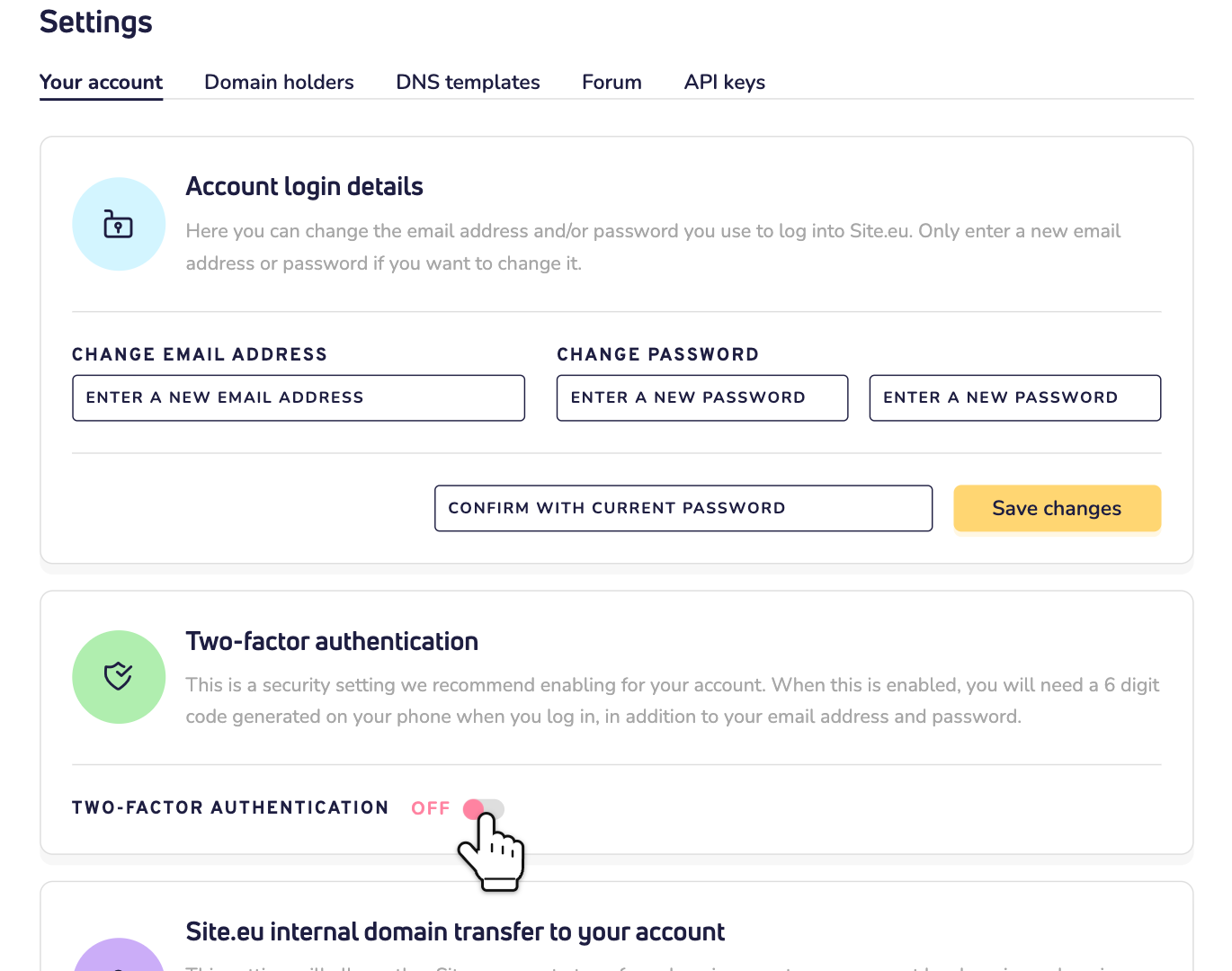
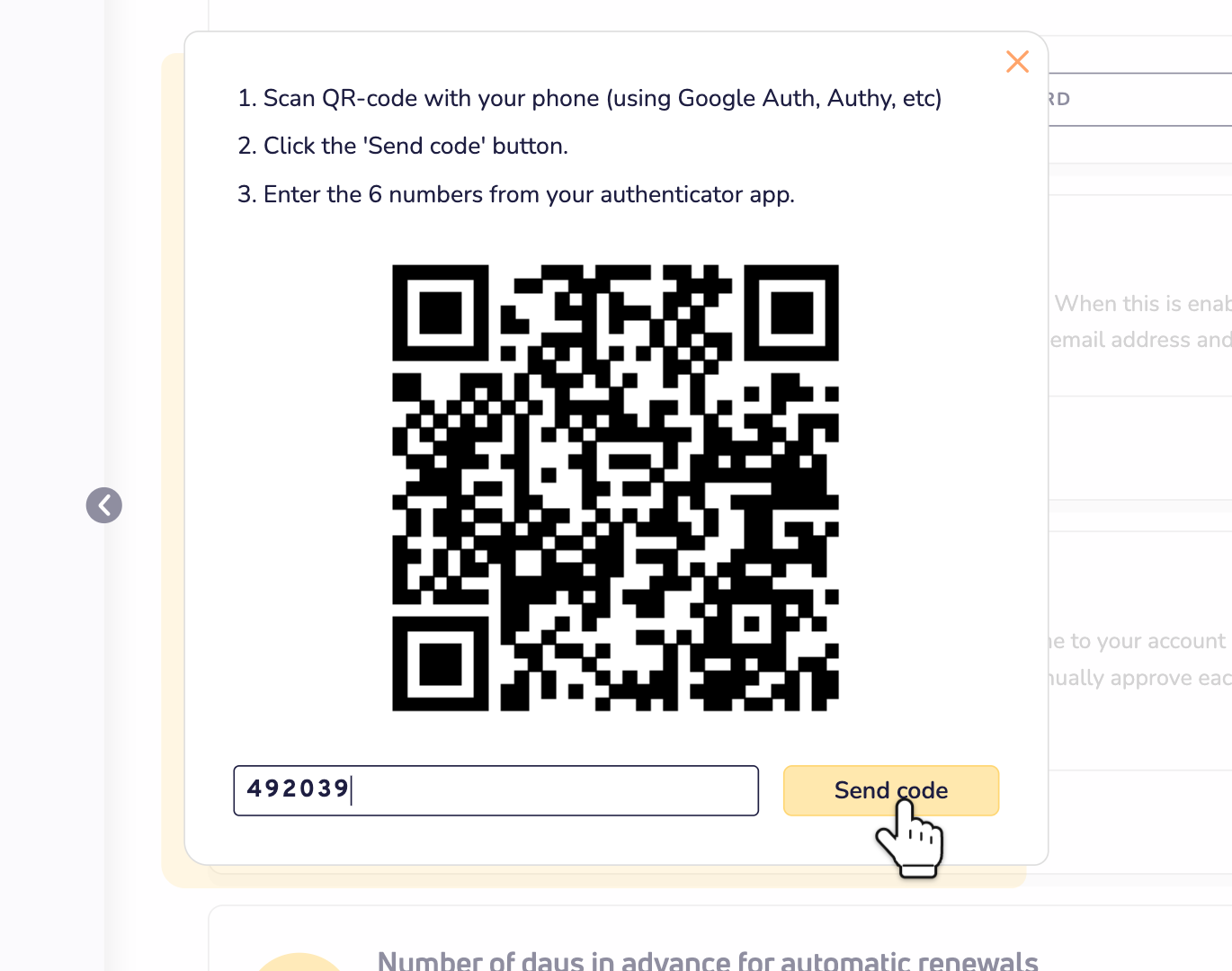
Step 2: A window with a QR code opens. Scan it with your authenticator app.
Step 3: Your app now shows a 6-digit code for Site.eu. Type it in the field and click Send code.
Step 4: You see Two-factor authentication has been successfully enabled. That's it!
Want to turn it off later? Click the same switch, enter a code from your app and click Disable.
Using 2FA when logging into your account at Site.eu
With 2FA on, you log in as usual with your email address and password. Then we ask for a code. Open your authenticator app and enter the 6 digits it shows for Site.eu.
Code not accepted? Each code is only valid for about 30 seconds. Wait for the next one and try again. Still not working? Check that the time on your phone is set automatically. The codes depend on it.
Lost your phone, or no access to your app anymore? Read what to do if you forgot your two-factor authentication.
Protect your account at Site.eu
Your account holds your domain names, your plans and your personal data. So protect it well. Turn on 2FA, use a strong password and keep your email account safe. Want to change your password or email address? Here's how to change your login information.