
A top-level domain (TLD) is the last part of a domain name, after the last dot: .uk, .com or .eu. Learn what types there are and how to choose.
You may know it as a domain extension, domain ending or just extension. It's all the same thing. You'll also read who runs the extensions and whether your choice matters for Google.
What is a top-level domain (TLD)?
Take the domain name yourbakery.com. The TLD is .com. Every domain name ends in an extension like this. Without one, you can't register a domain name.
Why "top-level"? The internet looks up addresses with DNS. DNS works in levels, and the TLD is the highest level you see in an address. Think of the country on an envelope. It's written at the bottom, but the post looks at it first.
TLD vs domain name vs subdomain: the levels of a domain
You read a web address from right to left. Each dot separates a level. Take shop.yourbakery.com:
- .com is the TLD. That's the first level.
- yourbakery is the name you choose. That's the second level. Together with the extension, it's your domain name: yourbakery.com. That's what you register.
- shop is a subdomain. That's the third level. You create it yourself under your domain name. You don't need to register it separately.
Above the TLD there's one more level: the root. You never see it in an address. But that's where every search for a website starts.
Some extensions have two parts, such as .co.uk. The TLD is .uk, and your own name sits on the third level: yourbakery.co.uk. You can also register straight under .uk, as in yourbakery.uk.
Types of TLDs: ccTLDs, gTLDs, new and brand extensions
Country code extensions (ccTLDs)
ccTLD stands for country code top-level domain. These are two-letter extensions for a country or region. Think .uk for the United Kingdom, .ie for Ireland and .de for Germany. And .eu, for the European Union, counts as a country code extension too.
Generic extensions (gTLDs)
gTLD stands for generic top-level domain. These extensions don't belong to any country. The best known are .com, .net, .org and .info. Anyone can register them, wherever they live.
New extensions
In 2012, ICANN held a big round for new extensions. It brought more than 1,200 of them. They're about a topic, a city or a region. For example .shop, .online, .london and .scot. Technically, they're gTLDs too.
Brand extensions (brand TLDs)
Some companies have their own extension, such as .microsoft and .sky. A brand extension is only for the company itself. You can't register a domain name under it.
Who manages domain extensions?
Three parties play a role:
- ICANN coordinates the domain name system worldwide. ICANN also decides on new extensions.
- IANA manages the root zone: the list of all TLDs and who runs them. ICANN carries out this IANA function.
- The registry runs the extension itself. For .uk and .co.uk, that's Nominet. For .eu, it's EURid, and for .com it's Verisign. The registry sets the rules: who may hold a domain name and which details are needed.
You don't register a domain name with the registry itself. You do it through a provider, such as Site.eu. We handle the registration with the registry for you.
What is a TLD server?
Every extension has its own name servers: the TLD servers. They know which name servers belong to each domain name with that extension. The registry makes sure they work.
Type yourbakery.co.uk in your browser, and your internet provider's DNS server looks it up like this:
- The root servers point to the TLD servers of .uk.
- The .uk TLD servers point to the name servers of yourbakery.co.uk.
- Those name servers give the IP address of the website.
This usually takes a fraction of a second. The answer is also remembered for a while. So the next time, it's even faster.
Which domain extension should you choose?
At Site.eu, you can choose from more than 1,000 extensions. These questions help you pick:
- Who are your visitors? Mainly in the UK? Then .co.uk or .uk is the obvious choice. Want visitors from abroad too? Add .com.
- Is the name still free? Search for your domain name and see at once which extensions are still free. Some names cost more, because the registry marks them as premium. Read what premium domain names are.
- What are the rules? Every registry has its own conditions. A .eu, for example, is only for citizens of the EU, Iceland, Liechtenstein and Norway. And for people and organisations who live or are established there. So a business based only in the UK can't hold one. Other extensions ask for extra details about the domain holder, such as an ID number or a company registration number. Read how to make a contact ready for a domain extension.
- Is there a minimum term? Some extensions must be registered for at least two or three years.
- What does the extension say? An extension like .shop or .london shows at once what you do or where you are.
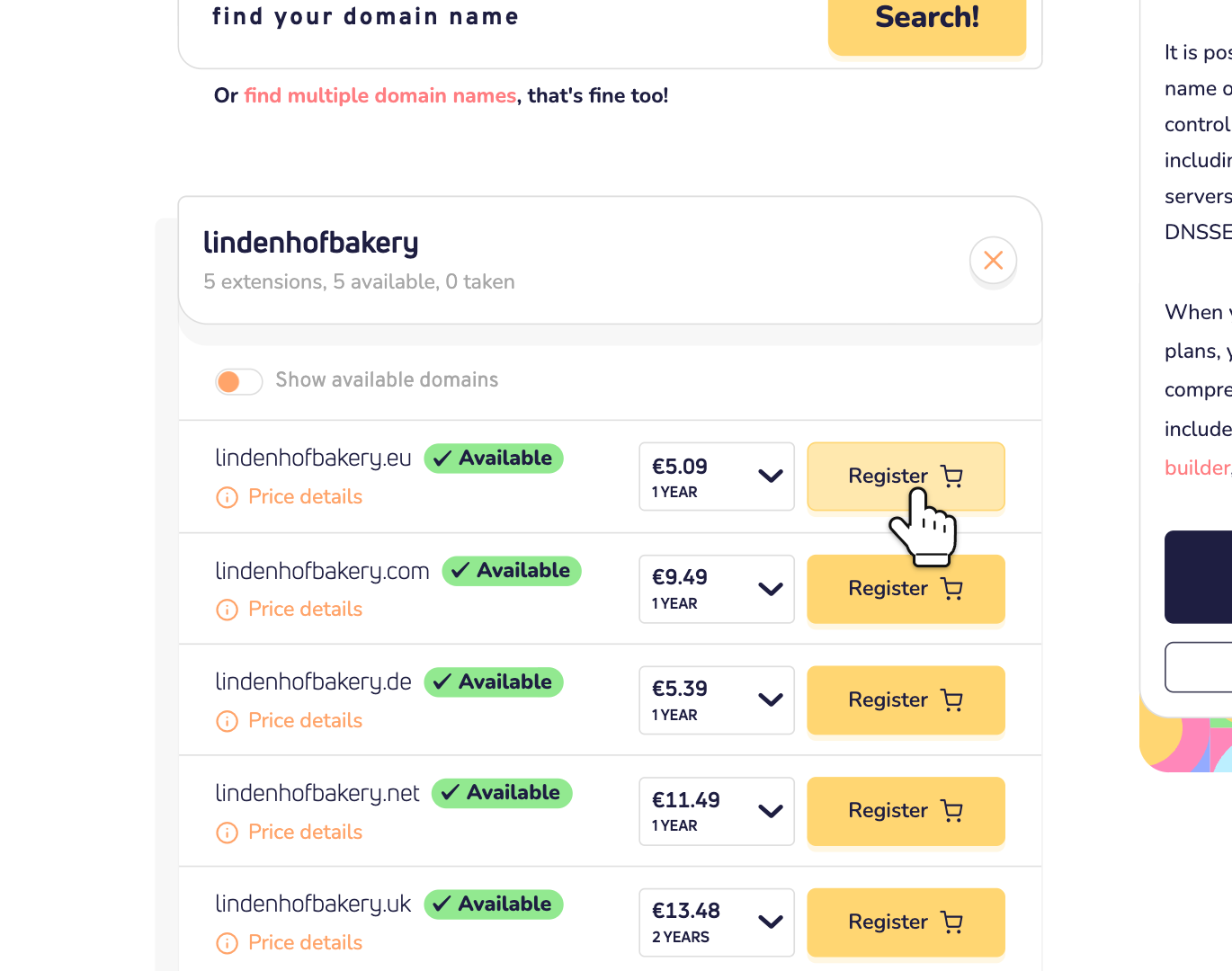
Tip: register your name with a few extensions, for example .co.uk and .com. Then nobody else can use them. Redirect the extra domain names to your website. Read how to create a redirect.
Want to compare? Our TLD list shows every extension we offer.
Does the domain extension matter for Google?
A little. Mostly when you target one country. According to Google Search Central, it works like this:
- A country code extension such as .uk is a strong signal that your website is meant for that country.
- Google sees .com, .org and also .eu as generic. For Google, they don't belong to one country.
- Google also treats a few country code extensions as generic, such as .io, .me and .tv.
- Google treats new extensions such as .shop or .london just like .com. A keyword in the extension gives no advantage and no disadvantage.
Targeting the UK? Then .co.uk or .uk makes that clear at once, to Google and to your visitors. But a .shop won't push your online shop higher in Google. So pick the extension that suits your visitors.
TLD FAQs
Can I buy just a domain name?
Yes. At Site.eu, you can register just a domain name. Web hosting, email and a website builder are optional. Read what you can do with only a domain name.
Can I change my domain extension later?
No. A .co.uk and a .com with the same name are two separate domain names. Want a different extension? Register the new domain name as well. Then redirect the old one to the new one.
How many TLDs are there?
IANA's list now has more than 1,400. And more are coming: in 2026, you could apply to ICANN for your own extension again. At Site.eu, you can register more than 1,000 of them.
Questions about extensions? Contact us via WhatsApp, Telegram or email.